What Is Chunk-Based Learning?
Linguists have discovered that native speakers don’t actually build sentences from grammar rules in real time. Instead, they recall pre-made chunks — complete phrases stored in memory as single units. When a French speaker says “Je voudrais un café, s’il vous plaît,” they’re not conjugating “vouloir” in the conditional and attaching a polite formula. They’re pulling a ready-made chunk from memory.
Chunks are complete phrases ready to use in conversation. They include the grammar, the vocabulary, the word order, and the natural rhythm of the language — all bundled together. When you learn a chunk, you learn all of these things at once without having to think about any of them separately.
This is the core insight behind chunk-based learning: instead of studying the pieces and trying to assemble them, you learn the finished product and use it immediately.
Why Grammar-First Fails
Most language apps and courses start with conjugation tables and grammar rules. You learn that “être” conjugates to “je suis, tu es, il est, nous sommes...” and that adjectives agree in gender and number. You study the passé composé, the imparfait, and the subjunctive.
The problem: you can conjugate perfectly on paper but freeze completely in conversation. Real speech happens too fast for real-time grammar assembly. When someone asks you a question in French, you don’t have time to recall the conjugation rule, apply the gender agreement, check the tense, and construct a grammatically correct sentence. By the time you’ve worked it out, the moment has passed.
Grammar-first learning produces people who can pass written tests but can’t order a coffee. Chunk-based learning produces people who can speak from the very first lesson.
How Children Learn Language
Children don’t learn grammar first. No toddler sits down with a conjugation table. Instead, they learn complete phrases: “I want milk,” “Can I have...,” “Where’s Mummy?” They use these phrases long before they understand what a verb or a noun is.
Only later — often years later — do children begin to understand the underlying grammar. And even then, they learn it implicitly through pattern recognition, not through explicit rules. They notice that “I want milk” and “I want juice” share a pattern, and they start substituting new words into familiar chunks.
Chunk-based learning mirrors this natural process. You start with complete, useful phrases. As you learn more chunks, you naturally begin to see the patterns — the grammar reveals itself through use, not study.
The Science of Immersion
Studies in applied linguistics show that learners who memorize complete phrases achieve conversational fluency significantly faster than those who study grammar rules in isolation. This is because phrases build two critical skills that grammar drills cannot: pattern recognition and natural rhythm.
When you learn “Je voudrais...” as a chunk, you also absorb the melody of a polite French request. When you learn “Est-ce que vous avez...?” you internalize the rhythm of a French question. These patterns transfer to new situations automatically. You don’t need to think about intonation rules — your brain has already encoded the pattern.
This is the same mechanism that makes immersion so effective. People who move to France learn fast not because they study grammar harder, but because they’re exposed to thousands of real phrases in context. Chunk-based learning recreates this effect without requiring you to move to Paris.
How ParleFlow Uses This Method
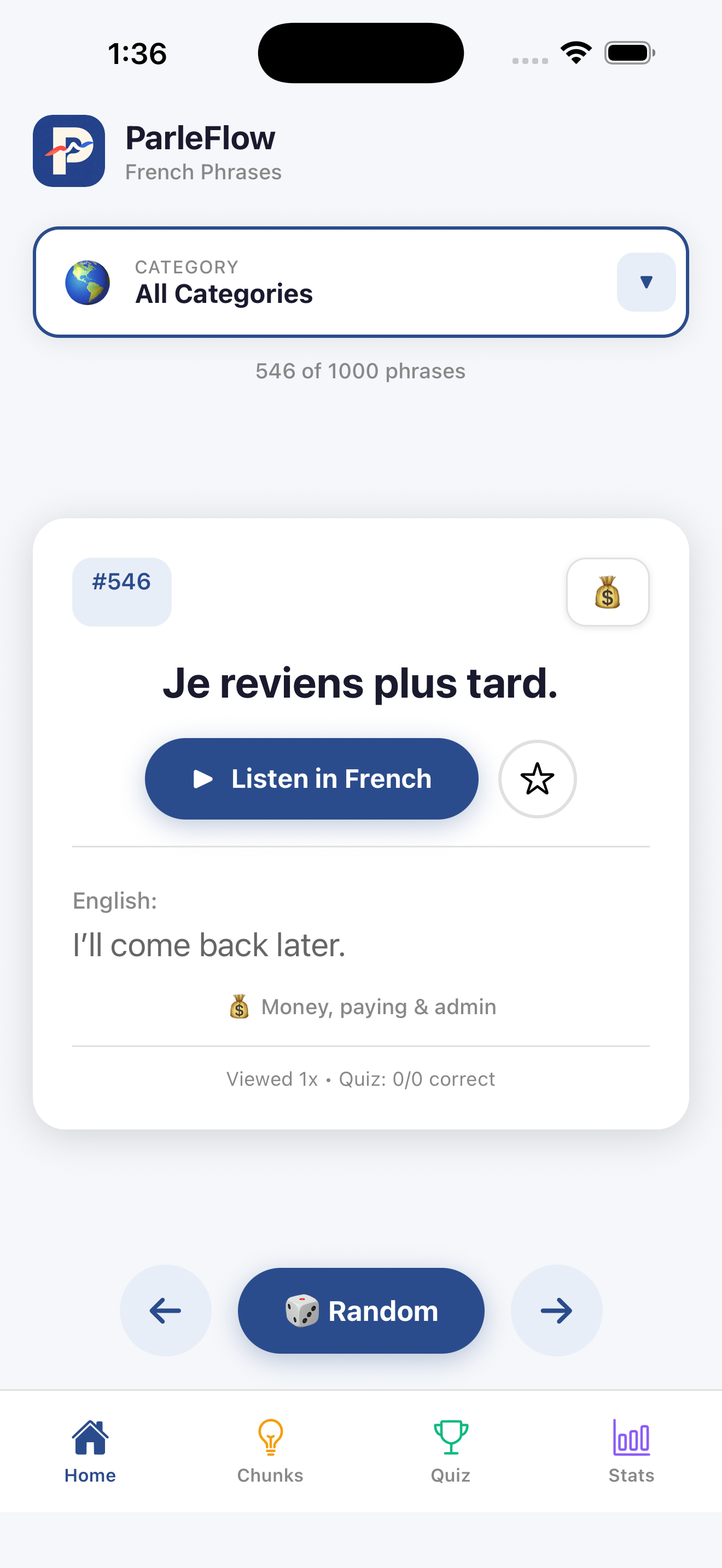
ParleFlow is built entirely around chunk-based learning. The app contains 1,000 complete Parisian French phrases, each one a ready-to-use chunk that you can deploy in real conversation.
Phrases are organized by real-life situations: ordering at restaurants, navigating the métro, checking into hotels, shopping at markets, making small talk, and more. This means you learn phrases in the context where you’ll actually use them, which dramatically improves recall.
Every phrase comes with audio pronunciation recorded in authentic Parisian French, so you learn not just the words but the natural rhythm and intonation. You hear how the phrase sounds in real speech, not in a robotic textbook voice.
There are no conjugation tables. No grammar exercises. No fill-in-the-blank drills. Just real phrases, organized by real situations, with real audio — exactly the way your brain is designed to learn language.
Try ParleFlow for free. 200 phrases with audio. No credit card needed.
Frequently Asked Questions
Yes, for conversation. Grammar study builds theoretical knowledge. Chunk-based learning builds practical speaking ability. The fastest path to speaking French is learning complete phrases you’ll actually use in real situations.
Research suggests 300–500 well-chosen phrases cover most daily situations. ParleFlow includes 1,000 phrases to give you comprehensive coverage across restaurants, travel, shopping, socializing, and more.
Yes. Most native French speakers can’t explain their own grammar rules. You absorb grammar naturally through repeated exposure to complete phrases. The patterns become intuitive over time, just as they did when you learned your first language.
Most users report being able to use phrases in real conversation within the first week. The key is learning phrases relevant to your daily life. Unlike grammar study, chunk-based learning gives you usable language from day one.
Duolingo teaches grammar rules and individual words through gamified exercises. ParleFlow teaches complete, ready-to-use phrases organized by real-life situations, focused specifically on Parisian French. Every phrase in ParleFlow is something you’d actually say in Paris.